RemoteEvents vs RemoteFunctions in Multiplayer Games
Know which tool prevents bugs: RemoteEvents for fire-and-forget, RemoteFunctions for responses.

RemoteEvents and RemoteFunctions solve two different problems in multiplayer games, and mixing them up is how performance bugs, reliability bugs, and logic bugs sneak into a project. One is a one-way message you fire and forget. The other is a question you ask and wait for an answer to. A third tool, UnreliableRemoteEvent, joined the lineup in 2023 for a narrower job than either. This article breaks down when to reach for each one, and why the wrong pick compounds as a game grows.
Server-client communication and its effect on game behavior
Multiplayer games run on two machines that never share memory: a server that holds the real version of the game, and a client that renders one player's view of it and collects that player's input. The server owns game logic, data persistence, physics authority, and anti-cheat checks. The client handles rendering, local UI, and whatever buttons the player is mashing. Neither side can reach across and call a function on the other directly. They can only pass messages back and forth, like two people talking through a wall.
That wall exists for a reason that has nothing to do with engine preferences and everything to do with trust. Any client can be hacked, modified, or run through software that lies about what the player is doing. A server that believed whatever a client told it would hand out free items, teleport players through walls, and generally turn into a casino with no dealer. So even something as simple as buying an item can't be resolved entirely on the client: the client asks, the server checks the player's balance, the server deducts the cost, and the server confirms. The client also can't feel a player's keypress happen on the server. It has to report that keypress across the wall itself.
Two built-in tools exist to cross that wall: RemoteEvents and RemoteFunctions. A third, UnreliableRemoteEvent, was added in 2023, and all three names come up repeatedly through the rest of this piece.
What RemoteEvents, RemoteFunctions, and UnreliableRemoteEvents do
The three primitives split along three axes: direction, timing, and whether delivery is guaranteed. Picking between the three primitives depends on precisely understanding each of those three axes before moving into strategy.
A RemoteEvent is one-way and fire-and-forget. The sender fires it and keeps running immediately. The recipient handles it whenever it shows up on their end. There's no return value, and delivery is guaranteed and ordered, meaning messages arrive in the sequence they were sent.
A RemoteFunction is two-way. It's a request-and-wait mechanism: the caller pauses (the technical term is "yields") until the other side runs its callback and sends something back. It behaves synchronously across a boundary that is, by design, usually asynchronous.
An UnreliableRemoteEvent looks like a RemoteEvent on the surface (one-way, fire-and-forget) but comes with a catch. Delivery isn't guaranteed, and packet order isn't preserved. Under network load, the engine may simply drop a packet.
All three need to live somewhere both the server and every client can see, which in practice means ReplicatedStorage, though Workspace or a Tool can work in specific cases. A remote tucked away in ServerStorage or StarterPlayerScripts is invisible to one side of the conversation, which defeats its purpose. One more mechanical limit applies to all three: functions can't be passed as arguments. Only data serializes across the boundary, so a function argument arrives on the other side as nil.
Why RemoteEvents cover most communication needs
Most server-client communication in a multiplayer game only needs to go one direction, and the sender rarely needs to sit around waiting for an answer. That's the case for RemoteEvents as the default choice, and it's not a close call.
Think about the player actions that only need to reach the server: jumping, swinging a weapon, interacting with a door, requesting a checkpoint save. None of these need the client to freeze mid-script waiting for permission. Server broadcasts work the same way in reverse: a building got placed, a round started, a player died. The server fires the message to everyone and moves on to the next thing. Per-player notifications follow the same pattern at a smaller scale: a damage number popping up, a UI element updating, a sound playing. The server fires to one client and doesn't need anything back.
The practitioner consensus lines up with this logic: RemoteEvents are the right default, and RemoteFunctions earn their keep only in the minority of cases where a return value has to be used in the same scope the request came from. The asynchronous behavior of a RemoteEvent is a feature. The client spins up a new handler thread the moment a message arrives, continuing its own execution immediately.
This default draws a real objection that deserves a straight answer. Simulating a two-way conversation with two separate RemoteEvents (one in each direction) adds coordination overhead that a RemoteFunction's built-in yield would avoid, and that overhead can trip up newer developers. That coordination problem is manageable: a correlation ID in the payload, or a dedicated named response event, solves it cleanly. The risks that come with RemoteFunction misuse, which get covered next, are worse than the coordination tax of doing two events properly.
Using RemoteFunctions without creating reliability bugs
RemoteFunctions earn their place when the calling code genuinely can't continue without a value coming back from the server in that same execution scope. That condition arises less often than most developers assume walking in.
A clean example: a client script needs to know whether a purchase went through before it updates the shop UI. The return value drives what the very next line of code does, in the same scope the request was fired from. Another: pulling a player's currency balance at the start of a session, before the shop even renders. The practitioner rule of thumb holds up well here: if the response needs to be handled in the same scope the request was sent from, reach for a RemoteFunction. Otherwise, the asynchronous RemoteEvent pattern is the better fit.
Direction changes the risk profile enormously, and this is the part of RemoteFunctions that catches people off guard. Calling from client to server, using InvokeServer, keeps risk contained, since the server controls its own callback. If the server errors out, the client's yield just fails and that's the end of it. Calling from server to client, using InvokeClient, flips that safety net upside down: now the server's own execution depends on a machine it doesn't control and can't fully trust. If that client throws an error, the server throws it too. If the client disconnects in the middle of the call, InvokeClient errors on the server. If the client never bothers to return a value at all, the server hangs there waiting indefinitely, which is a denial-of-service vulnerability sitting in plain sight.
The rule that falls out of all this is simple: avoid InvokeClient in production game logic. If a two-way exchange from server to client is genuinely needed, use two RemoteEvents instead to sidestep the hang risk.
One advanced pattern breaks that rule on purpose. A deterministic, tick-based simulation can use InvokeClient wrapped in its own dedicated thread per player, giving the server pull-based control over input pacing. That's a deliberately engineered architecture built by someone who has already accounted for the failure modes above, not a pattern to reach for casually.
What UnreliableRemoteEvent trades away
UnreliableRemoteEvent gets misread constantly as a faster version of RemoteEvent. It's a different trade-off entirely, built for data that updates continuously, arrives often, and doesn't carry lasting consequences if a piece of it goes missing.
The mechanism behind it: under network load, the engine drops packets instead of queuing them up to send later. That keeps latency low when the network is congested, but it comes at a real cost. Some messages never arrive, and the ones that do can appear out of order. Testing from the developer community backs up what the design implies: unreliable remote events aren't faster and don't send less data than regular ones. The benefit appears in how the system behaves under load, not in raw throughput. Anything receiving this kind of data needs to handle messages arriving out of sequence, typically by stamping each payload with a timestamp and discarding anything older than the last one already processed.
The right fit for this tool is anything where a missed or reordered packet goes stale before it matters. Per-frame camera aim direction is a good example. So is monster position syncing, or triggering a hit-effect visual. A bad fit is anything that changes permanent state: awarding currency, signaling a round transition, confirming a purchase. Lose one of those packets and the game is stuck in an inconsistent state with no way to recover.
With UnreliableRemoteEvent in the mix, the choice stops being a simple either-or. It becomes a question with three parts: does the sender need something back? Does every message have to arrive? Does the order they arrive in matter?
How the three-tool decision plays out across game genres
Genre doesn't change the underlying rules, but it does create recognizable, repeating patterns worth knowing on sight.
In tycoon games, purchase confirmations run through RemoteFunction:InvokeServer() so the client knows whether a buy succeeded before it updates anything visually. Broadcast updates, like announcing a building was placed, go out through RemoteEvent:FireAllClients(), since the players just watching don't need anything returned to them.
In horror games, scripted scares and entity spawns fire through RemoteEvent:FireClient() aimed at one player at a time. That's intentionally one-way and targeted. Syncing a monster's position, though, runs on UnreliableRemoteEvent, since a dropped position update gets replaced by the next one a fraction of a second later anyway.
In shooters and other PvP games, hit detection has to run on a plain RemoteEvent with the server validating every hit on its own authority. Guaranteed delivery and correct ordering aren't optional here. A missed hit confirmation or a packet that arrives out of sequence opens the door to exploits.
In obbies, checkpoint saves and stage completions fire as one-way events straight to the server. The client doesn't need anything handed back to keep playing, which makes RemoteEvent the obvious, uncomplicated choice.
The practical constraints that apply to all three tools regardless of which one is chosen
A handful of constraints apply no matter which of the three tools gets used, and skipping past them tends to produce failures that are silent and hard to trace back to their cause.
Serialization is the first one. Functions can't cross the boundary as arguments, full stop. One arrives as nil on the receiving end, which can quietly break a feature that looked fine in testing. Payload size is the second: events carrying data above a certain byte threshold get silently dropped rather than throwing a visible error, so large data structures need to be broken into smaller pieces or stored server-side and referenced by an ID. Rate limits are the third, and probably the one that catches developers off guard most often. RemoteEvent and UnreliableRemoteEvent each carry their own rate limit, a few hundred requests per second per client, shared across every instance of that type. Firing one on every frame, or inside a tight loop, will hit that ceiling fast, so firing patterns need to batch or debounce. The fourth constraint is storage: all three primitives need to sit in ReplicatedStorage so both the server and the client scripts can actually see them.
Storage placement and serialization limits are also part of why complex networking logic tends to live inside hand-built frameworks or templates rather than getting generated on the fly, a consideration that matters even more for a browser-based game builder like Paralov, which has to produce code that actually runs from a plain-language description.
A decision framework for choosing the right primitive at each design moment
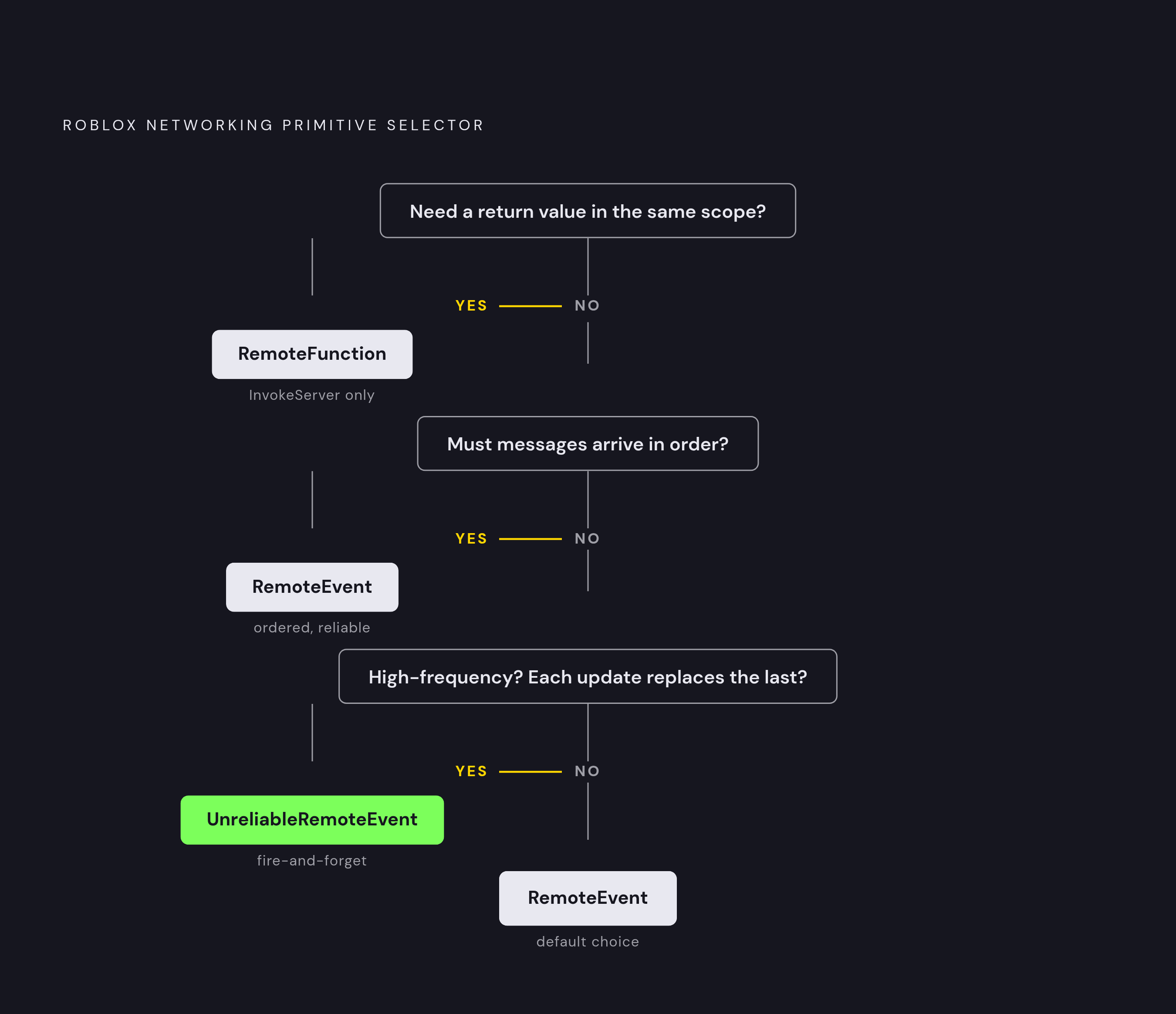
Three questions, asked in order, settle which primitive fits a given communication need.
The first question asks whether the sender needs a value back in the same execution scope it made the request from. If the answer is yes, a RemoteFunction is worth considering, and only in the client-to-server direction, for the reasons laid out earlier. If the answer is no, the decision moves to the second question: does every message need to arrive, and arrive in order? If yes, a RemoteEvent is the right call. If the answer there is also no, the third question is whether the data is high-frequency, with each update replaced almost immediately by the next one. If so, UnreliableRemoteEvent fits. If not, the default lands back on RemoteEvent, since reliability is almost always worth the small overhead when the data isn't firing constantly.
When a return value feels tempting but the InvokeClient risk makes it a bad idea, the two-RemoteEvent pattern is the fallback worth building instead: fire one event to the server, fire a separate named event back to the client, and handle the response in its own thread. Coordination overhead rises when more than one request might be in flight at once, so a correlation ID in the payload keeps responses matched to the right request. The InvokeClient case, where the server calls into the client directly, is the one to revisit last and only if the design truly demands it. When it does, isolate it in its own thread per player, wrap it in error handling, and keep it out of any shared server logic path where one stuck player could stall everyone else.
AI-assisted game creation tools and networking knowledge
AI-assisted tools can now scaffold a game's networking layer automatically, and that shifts what a developer needs to focus on without removing the need to understand any of it. Understanding the RemoteEvent and RemoteFunction decision still matters for debugging a bug report, iterating on a feature, and scaling a game past its first few thousand players. What's become optional is hand-writing every remote and callback from a blank script.
That shift raises the value of knowing the framework laid out in this article. A developer who understands why a hit-detection system needs a guaranteed-delivery RemoteEvent, or why InvokeClient is dangerous in shared server logic, can look at whatever an AI tool generates and catch the parts that don't hold up. Platforms like Paralov let creators describe a game concept in plain text and get a playable version back across genres including tycoons, obbies, shooters, and horror experiences. For a developer who wants to prototype the networking architecture of a new game mode before committing to a hand-written version, a tool like that can produce a working starting point to inspect, test, and modify. None of that changes what governs the underlying communication. The server still can't trust the client. A purchase still has to be validated before it's confirmed. Whether the baseline game came from a hand-written script or a generated one, the same boundary separates server and client, and the same three tools are what cross it.